JavaScript Closures, Scope, and this keyword
Introduction
Recently I have been learning JavaScript following The Odin Project. I came across this idea of closure and scope, which I was not familiar with during my Python learning. After experimenting with the Node.js debugger, the concept started making sense to me. I think it is worth recording and sharing in case someone has the same struggles.
Scopes, Lexical Scoping
The Odin Project (n.d.) defines scope as the current context of a variable. When a variable is not declared within any functions, existing outside any { curly braces }, they are said to be in the global scope, meaning that they are available everywhere. If they are within a function or { curly braces }, they are known to be locally scoped.
When any function is run, the function only cares about the scope in which it was defined. I understand this as lexical scoping. This is mentioned in this article by Wes Bos (n.d.).
Moreover, var is function scoped, let and const are block scoped (scoped in {}). const cannot be reassigned, let can be reassigned.
These are very clearly demonstrated in TOP’s sample:
let globalAge = 23; // This is a global variable
// This is a function - and hey, a curly brace indicating a block
function printAge (age) {
  var varAge = 34; // This is a function scoped variable
// This is yet another curly brace, and thus a block
  if (age > 0) {
    // This is a block-scoped variable that exists
    // within its nearest enclosing block, the if's block
    const constAge = age * 2;
    console.log(constAge);
  }
// ERROR! We tried to access a block scoped variable
  // not within its scope
  console.log(constAge);
}
printAge(globalAge);
// ERROR! We tried to access a function scoped variable
// outside the function it's defined in
console.log(varAge);
Closure and Scope Chain in JavaScript
Functions in JavaScript form closures. A closure refers to the combination of a function and the surrounding state in which the function was declared. This surrounding state, also called its lexical environment, consists of any local variables that were in scope at the time the closure was made. Here is an example:
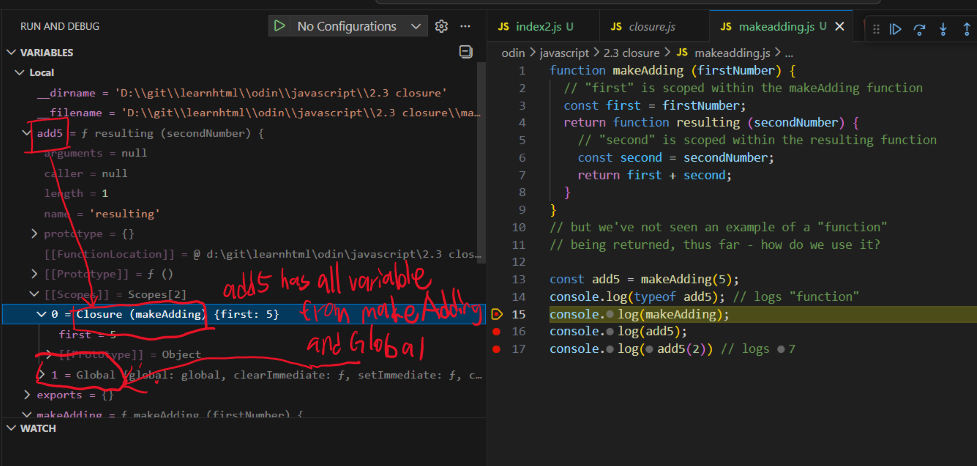
makeAdding() example
Here, add5 is a reference to the resulting function, created when the makeAdding function is executed, thus it has access to the lexical environment of the resulting function, which contains the first variable, making it available for use. The first variable is stored inside the Scope[0] closure with the returned function assigned to add5, on top of the Global scope.
So I came up with another understanding of closure, which is the ability to access a parent level scope from a child scope, even after the parent function has been terminated. The closure keeps its state between calls.
I asked GPT to generate another example for me, so I am able to examine the variables at the deeper level in the call stack easier literally. Here is the example and the call stack of the inner function when innerFn() ran.
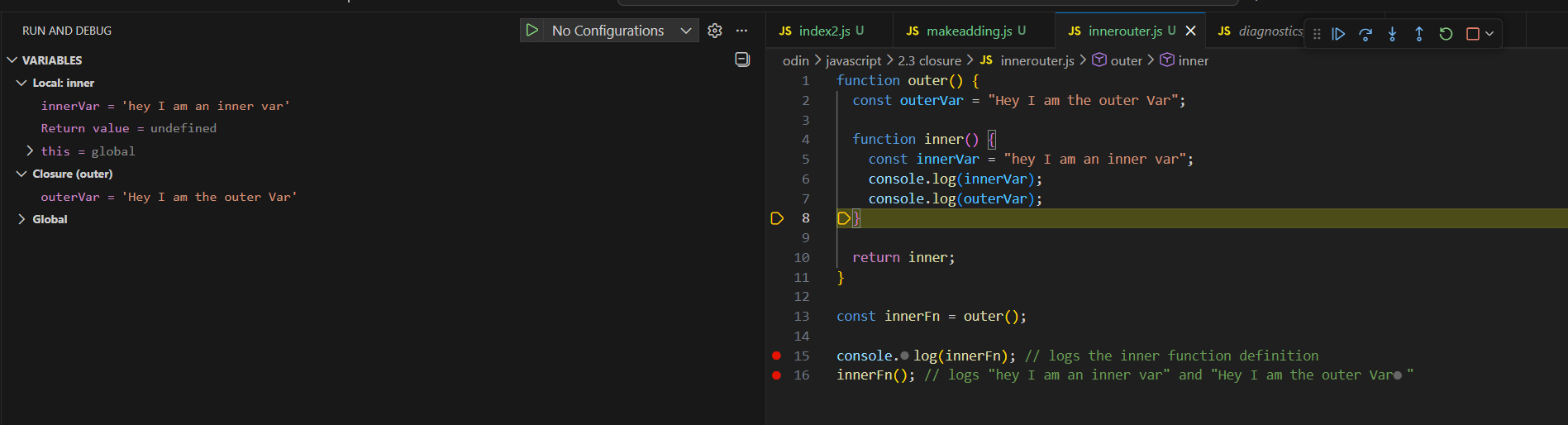
In this example, the outerVar exists in the scope before the function is called, just like the previous example. When the execution enters the inner function, the outerVar is stored in the Closure, and innerVar is stored in local as shown on the left side of Figure 2.
Nesting the Scopes
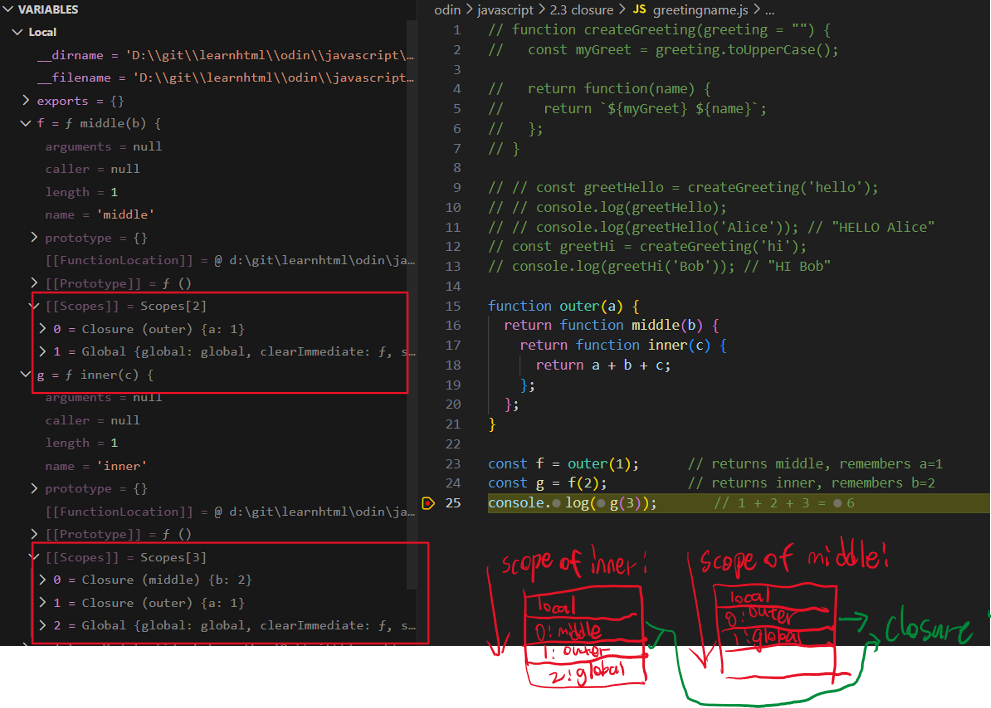
The closure process can be nested. Here is another code snipet created by GPT. You can have functions returning functions at multiple levels, and each inner function will “remember” all the variables from its own scope and all outer scopes up the chain. (but only when the outer variables are actually used)
function outer(a) {
  return function middle(b) {
    return function inner(c) {
      return a + b + c;
    };
  };
}

const f = outer(1);      // returns middle, remembers a=1
const g = f(2);          // returns inner, remembers b=2
console.log(g(3));       // 1 + 2 + 3 = 6
The scope of the inner and middle function is shown in Figure 3. I also drawn the hypothetical layers of local, closure and global variable according to my understanding.
The this Keyword and Context
But what if I want to access variables outside the defined function scope and its outer scope? This is where the this keyword comes in. this refers to the object that owns the function or method currently being executed. When you call a method on an object, this will refer to that object.
You can also explicitly set which object this refers to by using methods like .call(), .apply(), or .bind(). This allows you to control the context in which a function executes. Take this as an example:
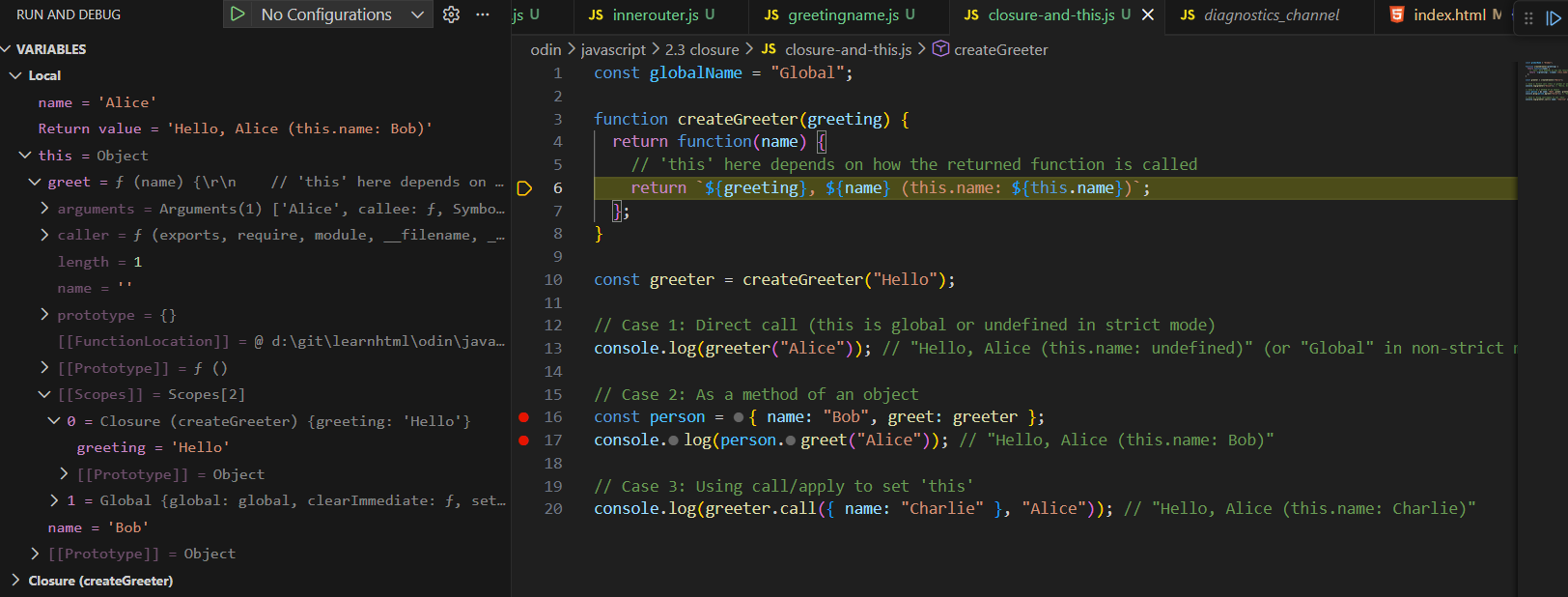
In JavaScript, the value of this inside a function is determined by how the function is called, not where it is defined. When you access this.name inside the returned function, JavaScript looks at the current value of this and tries to find a name property on that object.
When you call
person.greet("Alice"), JavaScript setsthisto thepersonobject becausegreetis called as a method ofperson. So,this.nameisperson.name, which is “Bob”.The object
personis transferred into the local variables section of the greeter function, marked asthisin Figure 4. Under thethisobject in local variable, there is aname = 'Bob'.
Exploring Shadowing
function createGreeter(greeting) {
  let name = "default";
  return function() {
    console.log(name);
    name = "defaultname";
    return `${greeting}, ${name} (this.name: ${this.name})`;
  };
}

const greeter = createGreeter("Hello");
const person = { name: "Bob", greet: greeter };
console.log(person.greet("Alice")); // "Hello, defaultname (this.name: Bob)"
In this example, there are two different variables named name, and this demonstrates the concept of shadowing:
- The first is the local variable
let name = "default";insidecreateGreeter. This variable is only accessible within the closure created bycreateGreeterand its returned function. It is updated to"defaultname"after the first call. - The second is the
nameproperty on thepersonobject (person.name = "Bob"), which is accessed viathis.nameinside the returned function.
When you call person.greet("Alice"), inside the function:
namerefers to the local variable, which starts as"default"and is then changed to"defaultname".this.namerefers to the property of the object that is the currentthiscontext, which isperson, sothis.nameis"Bob".
Although the name is confusing, now we have two things, a variable name = 'defaultname' shadowing the ‘default’ name in the createGreeter function, and an object this with a name = 'Bob' variable. So the output becomes "Hello, defaultname (this.name: Bob)".
Notes
I hope this article helps, documenting these also help me understand the concept better. You can leave a comment below.